
6th century
The Tea Horse Road runs from Yunnan to Tibet. Pu'er is traded for Tibetan horses, and the trails stay in use until the 20th century. Porters carry 60–90 kg of tea on their backs, often more than their own body weight. (Wikipedia)
Pu’er worth 13 times its weight in gold, tribute to the Qing emperors and a recipe by the eye surgeon who operated on Mao Zedong: the story of one tea bag with six components
In brief
In November 2021, at an auction in Hong Kong, a stack of Song Pin Hao pu’er made no later than 1917 sold for HK$13.8 million. Gram for gram, that tea cost 13 times more than gold. Fohow Liuwei Tea is built around the same Yunnan pu’er, only aged three years or more, plus five Chinese herbs. The recipe belongs to Professor Tang Youzhi, the eye surgeon who removed Mao Zedong’s cataract in 1975. It is made at the Fohow pharmaceutical plant in Tianjin and sold in Russia by WHIEDA. You brew a bag right with lunch, and five minutes later your cup holds a dark, mellow infusion, smooth and slightly sweet.
Ordinary tea fades with time. Pu'er matures for years, like wine, which is why every cake is marked with its year and place (Wikipedia). Raw pu'er needs 10 to 30 years of dry storage before its infusion “turns red”. In China they say exactly that: 反红, “turned to red” (Wikipedia).
What happens inside the cake all those years? Young tea is rich in catechins, which make the infusion astringent and bitter. With age, the catechins oxidize and link up into a large dark pigment — theabrownin. Catechins go down, theabrownin goes up, and a sharp taste turns smooth (Nature Communications, 2019).
Lot 129 at the L&H auction in Hong Kong had been aged for more than a century. A stack — a “tong” in Chinese — is usually made of seven cakes. This one still lay in its original bamboo-bark wrapping. The auction house described its aroma: wood with a note of medicinal herbs. The Song Pin Hao label earned the nickname “the emperor of tea” (auction press release).
The hammer fell above the high estimate of 12.8 million. It's a record for the label, and the price doesn't even include the buyer's premium.
HK$13,800,000 ÷ 2,335 g = HK$5,910 per gram. The Hong Kong dollar is pegged to the US dollar in a 7.75–7.85 band, so a gram of the tea cost about 760 dollars. On the eve of the sale, 26 November 2021, a gram of gold cost 57.63 dollars. The tea was 13 times dearer. (HKMA, gold quote)
That's the stack's minimum age today: it can't have been made after 1917.
6th century
The Tea Horse Road runs from Yunnan to Tibet. Pu'er is traded for Tibetan horses, and the trails stay in use until the 20th century. Porters carry 60–90 kg of tea on their backs, often more than their own body weight. (Wikipedia)
10th century
The Blang people come to Jingmai Mountain and tame the wild tea. The tea trees there grow under the forest canopy, at 1,250–1,500 metres.
1729
Under the Yongzheng Emperor, Pu'er Prefecture is established in southern Yunnan. The tea took its name from its town. (Wikipedia)
Qing dynasty
The only dynasty in Chinese history whose tribute tea has survived to this day in the real thing. The Palace Museum, the former Forbidden City, keeps Yunnan pu'er from the palace storerooms. Large balls of pu'er there are wrapped in bamboo leaves. Next to them lie 84 tablets of pu'er paste, dark as lacquer, stamped with the character for “longevity” and with bats, a symbol of happiness. The tablets are packed in three layers in a bright yellow box decorated with dragons, and attached to it is a yellow note on the paste's healing power. (museum website, “Tea and the World” exhibition, 2023)
2008
Pu'er receives geographical indication status in China. Under national standard GB/T 22111-2008, only tea from the Yunnan large-leaf variety, picked and processed inside the protected zone, may bear the name. (Wikipedia)
2023
The ancient tea forests of Jingmai Mountain are inscribed on the UNESCO World Heritage List. It is the world's first heritage site dedicated to tea, and China's 57th. (China Daily, UNESCO)
The Song Pin Hao stack went to a collector, and no one is ever going to drink it. But pu'er aged three years or more you can brew today at lunch. A bag of Liuwei costs 43 ₽.
How do we know there's pu'er in Liuwei? The Chinese description of the tea lists first 普洱茶(三年以上): “pu'er, three years and older” (description on the Fohow website). And under the 2008 law, only Yunnan tea may be called pu'er. Three years is still youth for pu'er, but the leaf's sharpness has already mellowed. The same description calls the taste 润滑甘香: smooth, gently sweet, fragrant.
AgeingOver a hundred years
FormatA stack of cakes in bamboo bark, 2,335 g
PriceHK$13.8 million at auction
In companyOn its own, nothing added
FateCollection
AgeingThree years and up
FormatFilter bag, 2 g of blend
Price43 ₽ per bag
In companyFive herbs and cordyceps
FateA cup with breakfast and lunch
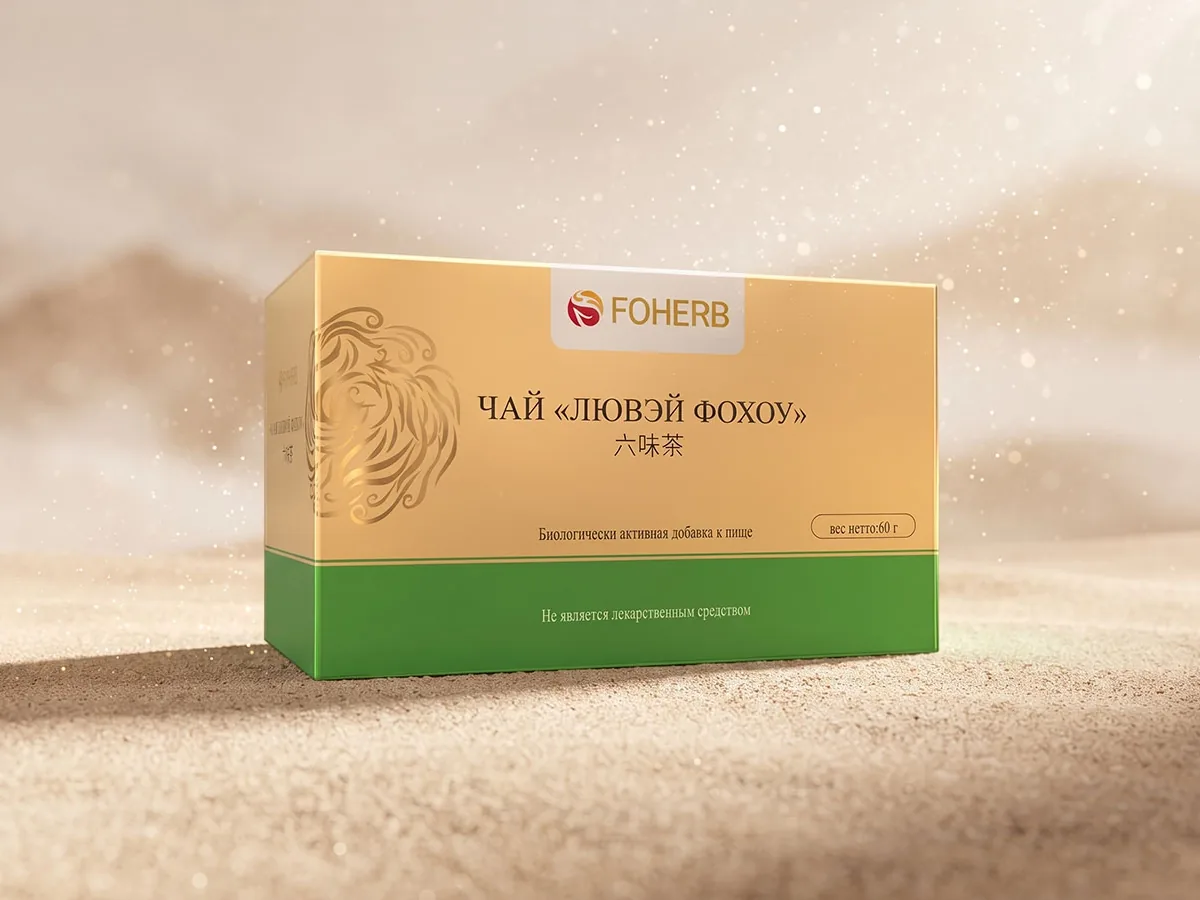
六味 literally means “six flavours”. But Chinese pharmacology knows only five flavours. The oldest herbal, the “Shennong Bencao Jing”, lists sour, salty, sweet, bitter and pungent (text of the herbal). There's nowhere for a sixth to come from.
The answer lies in how recipes are written. In a recipe, 味 is a counting word for one component of a blend (Wiktionary), so a Chinese reader sees 六味 as “six components”. The famous Liuwei Dihuang Wan pills are named the same way. They were devised by the children's doctor Qian Yi, and his student printed the recipe in 1119, 907 years ago (Wikipedia). The pills have their own formula; all they share with the tea is the count.
Liuwei has six components: pu'er aged three years or more, astragalus, danshen sage, five-leaf ginseng, chrysanthemum and honeysuckle. In China all six are classed as 药食同源 — plants that are food and medicine at once.
Who put these six together? The 六味茶 recipe belongs to Professor Tang Youzhi. The tea is the fruit of his many years of work, built on a family recipe (description on the Fohow website).
Tang Youzhi (1926–2022) was an eye surgeon, one of the very first “Great Masters of Chinese Medicine”, and honorary president of the China Academy of Chinese Medical Sciences (Wikipedia). On the evening of 23 July 1975, Mao Zedong had a cataract removed from his left eye. A team of seven ophthalmologists operated, and the lead surgeon was Tang, then 49 (The Paper). Since 2016 the Fohow plant has named the professor as its expert and develops products with him (plant website).
It's no accident that the blend includes chrysanthemum. In China it has been brewed for centuries “for bright eyes”.
Astragalus, 黄芪
The root's name was explained by the physician Li Shizhen in the “Bencao Gangmu”, 1578: “耆 means ‘elder’. The root is yellow, and among the strengthening herbs it is the elder.” (text)
Danshen sage, 丹参
It's the same genus as garden sage, only its root is red. The Latin name Salvia miltiorrhiza means “red-ochre root”. Folk names for it are “red root” and “blood ginseng”. And Chinese medicine has a saying: 一味丹参,功同四物 — one herb, danshen, is worth a whole “Four Substances Decoction”, the classic women's formula. That's why danshen is called a key herb of women's medicine. (Wikipedia)
Chrysanthemum, 菊花
The “Shennong Bencao Jing” says of it: 久服,利血氣、輕身、耐老延年 — “taken over time, it invigorates blood and qi, brings lightness, holds back old age and lengthens the years”. Legend has it that chrysanthemum wine was first drunk on the ninth day of the ninth moon back in the Han dynasty. On this festival, the Double Ninth, Chinese people still drink chrysanthemum tea, and in Taiwan the day has become Senior Citizens' Day. (Wikipedia)
Japanese honeysuckle, 金银花
The name means “gold and silver flower”. The blossom opens white, then turns yellow, so you can see both colours on one bush. Its second name is 忍冬, “the one that endures winter”: the vine keeps its leaves through the cold. It's so hardy that in the US it has become a weed. (Wikipedia)
Five-leaf ginseng, 五叶参
The sixth component, and the humblest in fame. Its name says it all: “ginseng with five leaves”.
Chinese cordyceps — the seventh
It isn't in the Chinese recipe; the mushroom was added on top of the six in the Russian version. How this mushroom became dearer than gold is told in our article on the Phoenix elixir.
That's how many herbs the “Shennong Bencao Jing” places in its top rank, as “sovereigns”: they can be taken for a long time without harm. Astragalus and chrysanthemum from Liuwei are among them.
A study of the ingredient, not the finished tea: small and with no control group. In Shanghai, thirteen healthy men aged 24–32 drank 300 ml of pu'er after breakfast and after dinner for four weeks. Total cholesterol and triglycerides in their blood went down, while their weight stayed the same. Scientists found the mechanism in mice: theabrownin, that very pigment of ageing, changes the gut flora and bile acid metabolism (Huang et al., Nature Communications, 2019).
Liuwei was made for an ordinary working day, with lunch in the middle and things to do until evening:
Lunch at the office
A hearty plate, and half a day at the desk still ahead. A cup of warm pu'er beside your plate, and you feel light after lunch. Tea with a meal reduces the amount of fat absorbed from food — that's what WHIEDA's description says.
Drinks bagged tea
An ordinary tea bag holds tea dust. This one holds aged pu'er and five herbs in the very same bag.
Loves tea with a story
Imperial tribute pu’er, a recipe by the eye surgeon who operated on Mao Zedong, herbs from a book written in 1578. A cup like this comes with a story to tell.
Looking for a meaningful gift
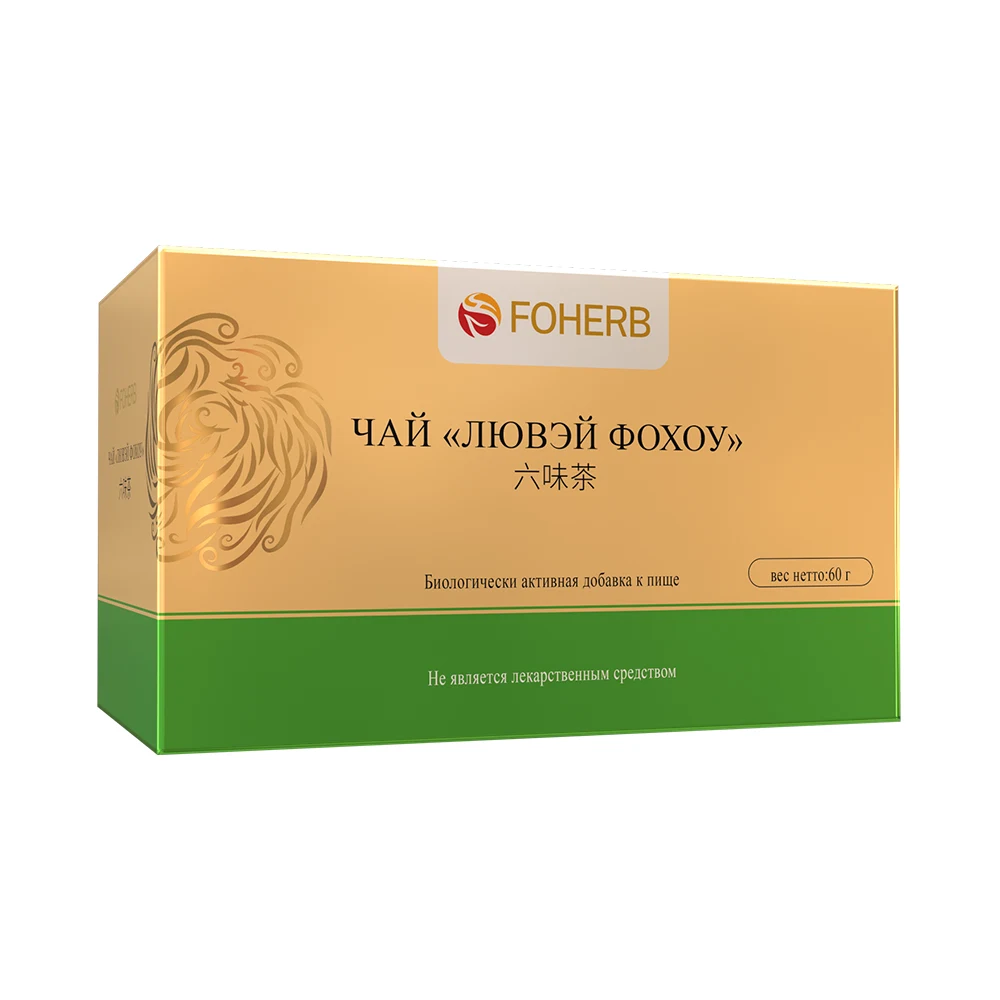
A gold box with the characters 六味茶 and 30 bags inside. A gift like this gets drunk, not left gathering dust on a shelf.
No teapot, strainer or tea ceremony needed. Everything follows the state registration certificate:
One bag per cup
One filter bag per 200 ml of water at 85–90 °C. Hot, but not at a rolling boil.
Five minutes
While you set the table, the tea steeps.
Twice a day, with meals
A cup with breakfast, a cup with lunch. Liuwei isn't for the evening.
A one-month course
That's 60 bags, two packs.
Liuwei tastes like pu’er with herbs, and it’s pleasant. The infusion is dark and mellow: ageing has already taken away the sharpness of the young leaf.
Individual intolerance to the components, pregnancy, breastfeeding, increased nervous excitability, insomnia, high blood pressure, heart rhythm disorders, taking it in the evening. Consult a doctor before use. Contains danshen sage — keep this in mind if you take blood-thinning medication.
RU.77.99.11.003.R.001358.04.21EAEU registration certificate
Issued on 23 April 2021 after review by the Federal Research Centre of Nutrition and Biotechnology, Russia's leading scientific centre for nutrition, and testing in its laboratory. It has no expiry date; the tea's shelf life is 36 months. Open PDF ↗
2024Kosher certificate
In 2024 Liuwei went through kosher certification. The certificate from Jerusalem rabbi Yosef HaKohen Zaritsky includes the line “FOHERB LIUWEI TEA”. Plant news ↗
GR202312000548High tech
The plant holds the state status of “High-Tech Enterprise”; the certificate was issued on 6 November 2023. Certificate scan ↗
WEF · 2023“Innovation” award
The World Economic Forum's New Champions Awards 2023 went to the FOHERB group, which the Fohow plant belongs to. WEF page ↗
Is the pu'er in Liuwei the same as at auctions?
Family, but not twins. Collector's cakes are aged for decades and carefully guarded. Liuwei uses pu'er aged three years or more for your everyday cup, and the bag holds five herbs and cordyceps alongside it.
What does Liuwei taste like?
Pleasant: it’s pu’er with herbs. The Chinese description calls the taste 润滑甘香: smooth, slightly sweet, fragrant.
How long does a pack last?
A pack holds 30 filter bags of 2 g each, 60 g net. Two cups a day makes 15 days. A month of the ritual takes two packs.
Does the tea contain caffeine?
Yes. The certificate lists Liuwei as a source of flavonoids and caffeine, and the caffeine comes from the pu'er. That's why the tea gives a gentle lift, and why the last cup is at lunch.
Who makes Liuwei?
The Fohow pharmaceutical plant in Tianjin, built in 2007. The box carries the FOHERB brand — the name of the group the plant belongs to. In Russia and the CIS the tea is sold by WHIEDA.
The pu’er is an imperial tribute tea, the recipe is Professor Tang Youzhi’s. Alongside it: astragalus, “the eldest of the tonics”, red danshen root, chrysanthemum of long life, gold-and-silver honeysuckle, five-leaf ginseng and cordyceps. All of it in one 2 g tea bag.
A pack of 30 bags costs 1,300 ₽; a cup of pu'er with herbs at breakfast and at lunch comes to about 87 ₽ a day. The tea's product page shows availability in your country.
Dietary supplement, not a medicine.